Mary Lucier at CAS
It’s the last weekend to catch an exhibition of video art and photography from Mary Lucier, the pioneering video artist, at Catskill Art Space (CAS).
Mary Lucier opens on Saturday, June 29, with an artist talk from 3-4pm followed by a reception from 4-5pm; the show remains on view through August 24. The opening will coincide with the release of the eponymous catalog, including new critical text and an interview with the artist from Hearne Pardee and Emily Watlington. Mary Lucier’s wide sweeping exhibition at CAS marks the first time the organization has exhibited video art, an ambitious endeavor for an institution of this size. The presentation is grounded by major historical and new works, tracing the breadth of her career—from her experiments with early video camera technology of the 1970s, to recent installations reflecting on her personal lived experience and loss of her late husband and painter Robert Berlind. Bridging the room-sized installations, is a gallery of still photography from her installation Noah’s Raven (1993), which captures catastrophic phenomena on the landscape and in the lives of individuals and cultures. Together, the exhibition examines the effects of ecological trauma, transformation, and resilience in the natural and artificial worlds.
For Equinox (1979/2016), a subversive meditation on nature and video, Lucier trained her video camera on the sun for twelve consecutive days, burning the camera tube and leaving more and more marks on the images, which are presented on seven pedestal-mounted monitors of increasing size. The burn marks track the movement of the sun, accumulating and creating a decidedly painterly effect with intoxicating washes of green over the glow of the rising sun. Presented nearly 50 years later, as we grapple with the impact of environmental degradation, the work reminds viewers of the orange glow that colored the city’s skies amidst the 2023 Canada wildfires, underscoring the devastation of global change. In this context, the work is as much about the natural world degrading technology, as the inverse—a city laid vulnerable to the impact of climate change.
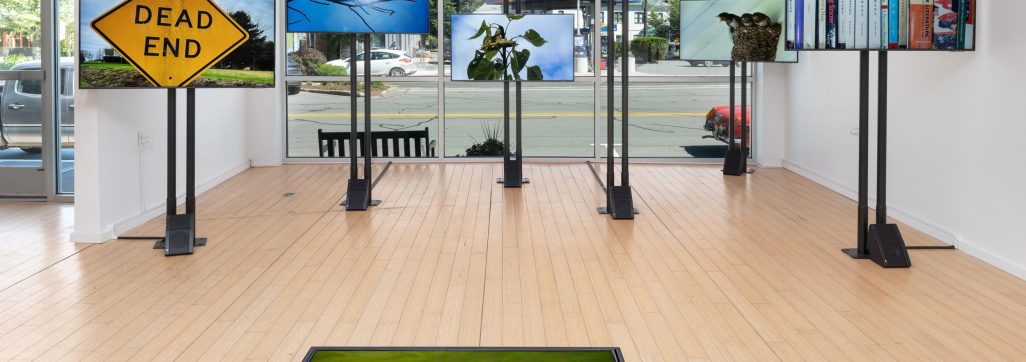
Leaving Earth (2024) is a multi-channel video and sound installation inspired by excerpts from the final journal of Lucier’s late husband, the painter Robert Berlind. In this journal, Berlind fearlessly documented his thoughts on his impending death from a terminal illness. His writings reflect his appreciation of life with a remarkable lack of anxiety about the inevitable end—more curiosity than dread. The imagery in Lucier’s work consists of sequences of protean video and still images filmed in both her domestic and working environments in Sullivan County and New York City. Most were shot after Berlind’s passing, reflecting the world as she experienced it during his final days and after. Berlind’s terse epigraphs appear throughout, serving as evocative companions to the flow of images in Leaving Earth.
Location